Muskellunge
Esox masquinongy
The fish of ten thousand casts that defines the pinnacle of freshwater apex predation.
Typical Size
30 to 45 inches and 15 to 30 pounds, with trophy specimens exceeding 50 inches and 40 pounds.
Prime Seasons
Early summer for post-spawn aggression and late autumn (the 'trough' period) for maximum body weight and feeding intensity.
Overview
The Muskellunge, or 'Musky,' is the largest member of the pike family and arguably the most elusive trophy in North American freshwater. Known for their incredible power, violent strikes, and unpredictable 'figure-eight' maneuvers at the boat side, they command a cult-like following among anglers who are willing to trade quantity for the chance at a true monster. Anglers target Musky for the sheer adrenaline of the chase and the test of endurance required to pursue these apex predators throughout a long season. Their ability to ambush prey with explosive speed makes every cast a potential heart-stopping encounter.
Identification
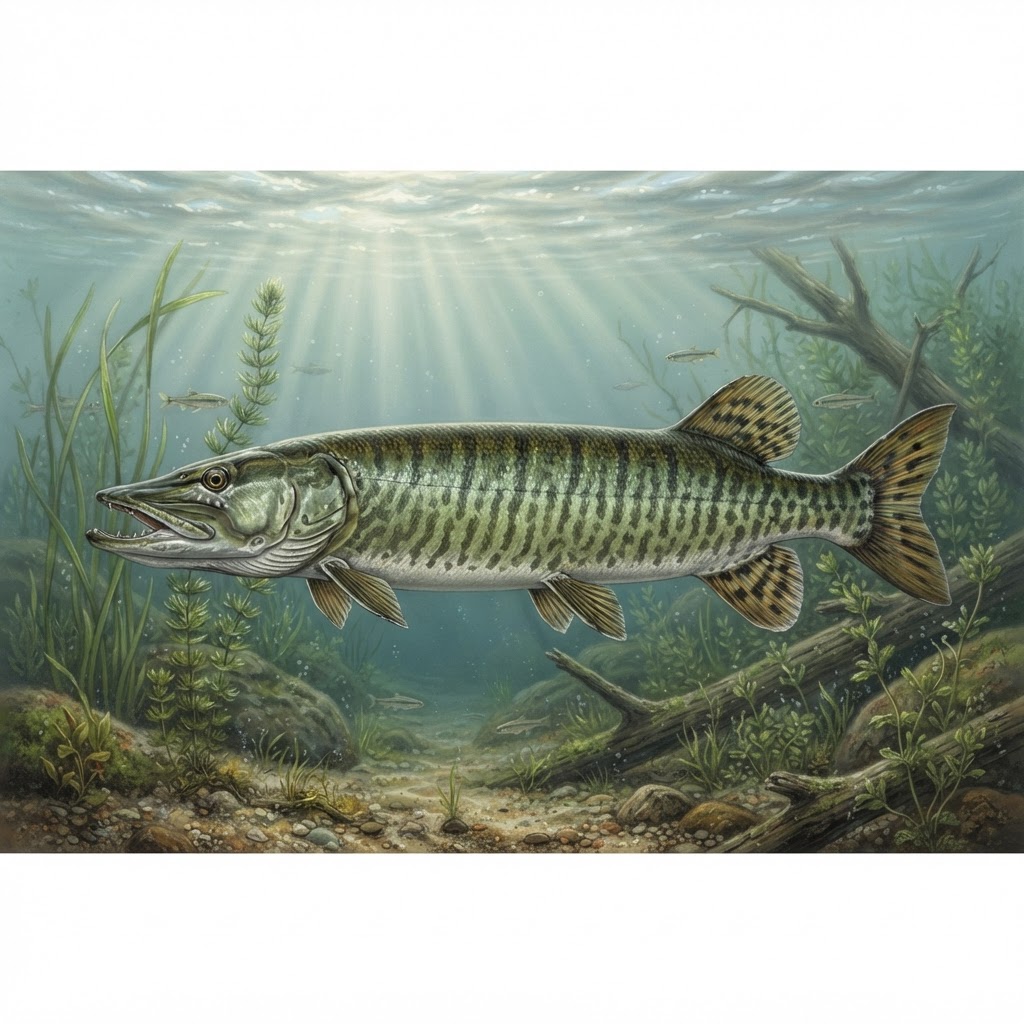
- Vertical dark stripes or spots on a light-colored background.
- Pointed tail fins compared to the rounded fins of a Northern Pike.
- 6 to 9 sensory pores on the underside of each side of the lower jaw.
- Very large, duck-billed snout with rows of needle-sharp teeth.
- Absence of scales on the lower half of the operculum (gill cover).
Habitat
Diet & Forage
Behavior & Feeding
Muskellunge are ambush predators that rely on explosive bursts of speed to capture prey, often holding tight to structural cover like weed edges or rocky drop-offs. While they can be active throughout the day, low-light periods such as dawn and dusk often trigger the most aggressive feeding windows. Their behavior is highly seasonal, with fish moving shallow in the spring, transitioning to open water or deeper structures in the summer heat, and returning to shallower, warming water in the autumn. Despite their reputation as the fish of ten thousand casts, they exhibit varying levels of aggression influenced heavily by water clarity and prey availability.
Spawning
Spawning typically occurs in early spring as soon as water temperatures reach the mid-40s to low-50s Fahrenheit, usually in shallow, vegetated bays with mucky or rocky bottoms. During this period, fish become less focused on feeding and are extremely vulnerable to disturbance, which is why many jurisdictions close fishing during this window. Once the spawn concludes, muskies often remain in shallow, warming areas to recover before beginning their post-spawn migration toward summer habitat. Successful anglers often target post-spawn females as they begin to aggressively feed to replenish energy stores.
Water Temperature
Weather Triggers
Falling Barometer
Often triggers a significant feeding frenzy; switch to aggressive, noisy lures to capitalize on increased activity.
Overcast Skies
Expands the strike zone by reducing light penetration; fish move shallower and are more likely to strike lures far from cover.
Post-Cold Front
Causes fish to become lethargic and tight-lipped; utilize neutral-buoyancy baits worked with long, slow pauses to induce strikes.
Depth by Season
Best Lure Rigs & Setups
Bucktail Spinner Rig
When: Essential for 'burning' over weed flats during the summer months.
Setup: Double #10 or #12 blades, 80lb fluorocarbon leader, 8ft heavy power rod with high-speed reel.
Jointed Swimbait
When: Effective for slow-retrieving in late autumn when fish are less prone to chasing fast baits.
Setup: 8-10 inch soft plastic glide bait, 100lb braided mainline, massive 7/0-9/0 treble hooks.
Trolling Crankbait Spread
When: Best for covering vast reservoir territory to locate suspended fish in summer.
Setup: Deep-diving crankbaits (e.g., DepthRaiders or Wiley lures), 10ft heavy trolling rods, planer boards.
Best Knots
Catch more muskellunge — free
Create a free account and unlock the full angling toolkit:

