
The Strategic Tackle Box: Balancing Versatility and Weight on the Water
The Art of Selective Packing
Every angler reaches a point where their gear feels like an anchor. You start with one small utility box, and three seasons later, you are lugging around a 40-pound hard case that requires a dolly to transport. At Buckeye Hunter Hub, we believe that true angling prowess isn’t measured by how much gear you own, but by how effectively you can adapt with a curated selection. Building a versatile tackle box is a balancing act between preparedness and portability.
Get in the Community feed
Hunters and anglers nationwide posting bucks, catches, trail cam pics and what's working right now.


The 'Swiss Army' Approach to Hooks and Weights
Versatility begins with your terminal tackle. Instead of carrying every size of hook imaginable, focus on the 'workhorse' sizes. For most bass, walleye, and panfish applications, a collection of 2/0 and 3/0 offset worm hooks covers your soft plastics, while size 6 and 8 octopus hooks are perfect for live bait rigs. By narrowing your selection, you save physical space and mental energy.
When it comes to weights, tungsten is the gold standard for sensitivity, but it comes at a premium price. Lead or bismuth weights are more budget-friendly and perfectly adequate for 90% of applications. Before you head out, check your to ensure your terminal tackle complies with local lead-free mandates, which are becoming increasingly common in various U.S. waterways.
Hardbaits: The 80/20 Rule
Raise a safe, confident young hunter.
Guide your kids ages 5–17 through interactive hunting safety missions, real decision drills, and earned trophies — all from one free parent account.
Bonus: every $10 you spend in the BHH shop earns a free seat (up to 5). Use them or share them.


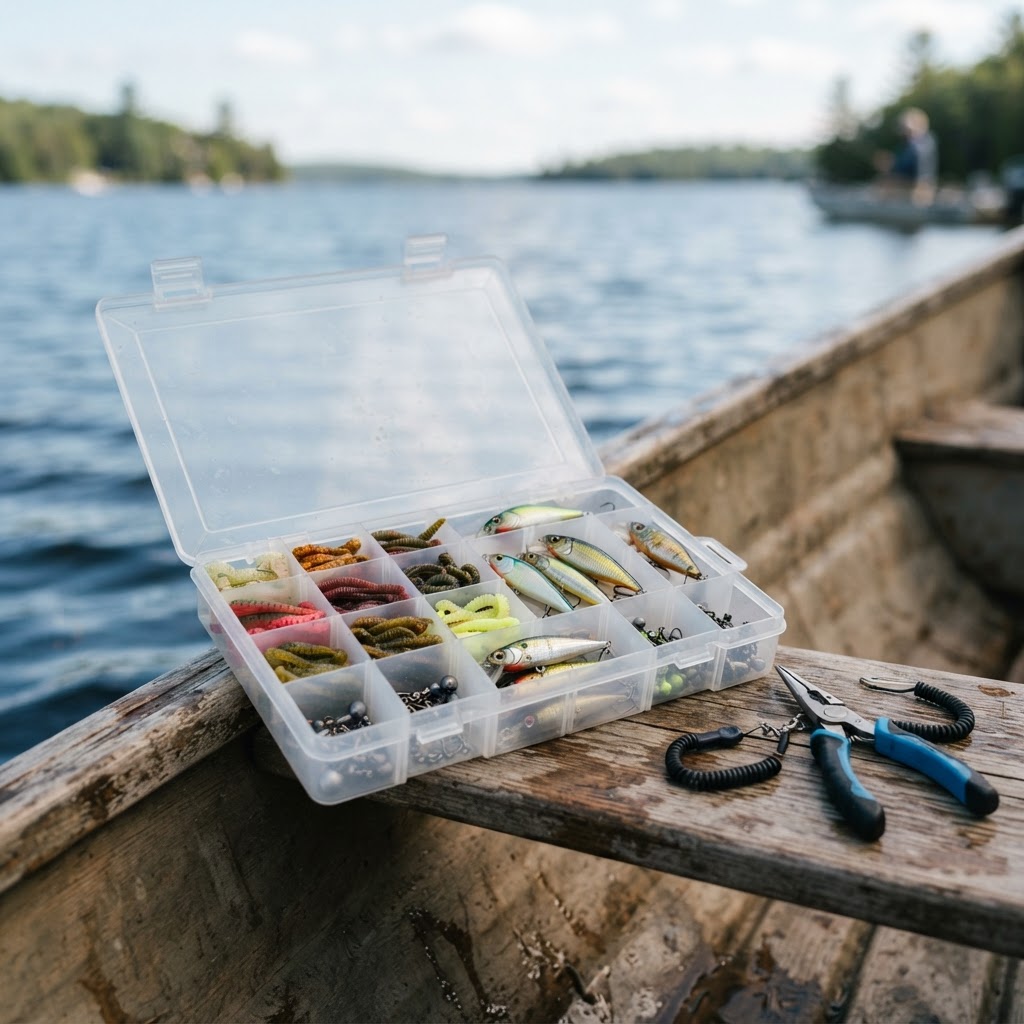
Apply the 80/20 rule to your hardbait collection: 80% of your fish will likely be caught on 20% of your lures. A versatile kit should contain three fundamental profiles: a shallow-running square bill for cover, a medium-diving crankbait for searching mid-depths, and a topwater walking bait.
If you find yourself struggling to identify which lures are trending in your area, consult our to see what species are active in your local watershed. When buying hardbaits, prioritize quality hooks over flashy paint jobs. A dull hook loses fish; a plain-colored lure with sharp, sticky hooks rarely does. If your budget is tight, focus on buying fewer, high-quality lures rather than a dozen cheap ones that break or run sideways out of the box.
Soft Plastics and the Power of Color
Soft plastics are the ultimate versatile tools, but they are also the primary culprits for 'tackle box bloat.' To stay lean, standardize your soft plastic shapes. Carry one 'creature bait' for flipping, one 'straight tail' worm for finesse work, and one 'paddle tail' swimbait. These three silhouettes can imitate almost any forage species in North America.
Regarding color, simplicity is your best friend. You only need three categories of color: natural (green pumpkin or watermelon), dark (black or blue) for murky water, and bright (chartreuse or white) for low-visibility or overcast conditions. For more detailed insights on how specific regions influence forage patterns, dive into our archives for seasonal tips.
Organization as Strategy
Physical organization determines how fast you can switch tactics. Use modular, clear utility boxes. Labeling the contents by application—such as 'Topwater/Search,' 'Finesse,' and 'Hardbait/Crank'—allows you to grab exactly what you need for the day's conditions. This prevents the 'everything bag' mentality and keeps you focused on the water, not on digging through tangles of spare line and mismatched hooks.
Always dedicate one small box to 'mission critical' items: leader line, scent attractant, a high-quality pair of pliers, and a hook file. Keeping these items accessible will save you time during a hot bite. For those looking for further reading on regulations or conservation efforts that might affect your gear choices, the U.S. Fish and Wildlife Service provides excellent guidance on responsible angling practices.
Knowing When to Pivot
The biggest trade-off in building a versatile kit is the fear of 'what if.' What if the fish are only biting on a deep-diving suspending jerkbait that I left at home? Accept that you cannot cover every contingency. If you find yourself in a scenario where your current box is failing, use it as a learning experience. Every time you have to pivot, you become a better angler. When you do land that trophy, make sure to share your success on the to help others see what your local, versatile setup is capable of achieving.
Ultimately, a versatile tackle box is a reflection of your confidence. By stripping away the excess, you are forced to learn the nuances of the gear you do carry. You will learn to fish your bait at different speeds, depths, and angles, which is a much more valuable skill than owning ten versions of the same lure. Keep it light, stay organized, and keep your hooks sharp.
Catch more these fish — free
Create a free account and unlock the full angling toolkit: