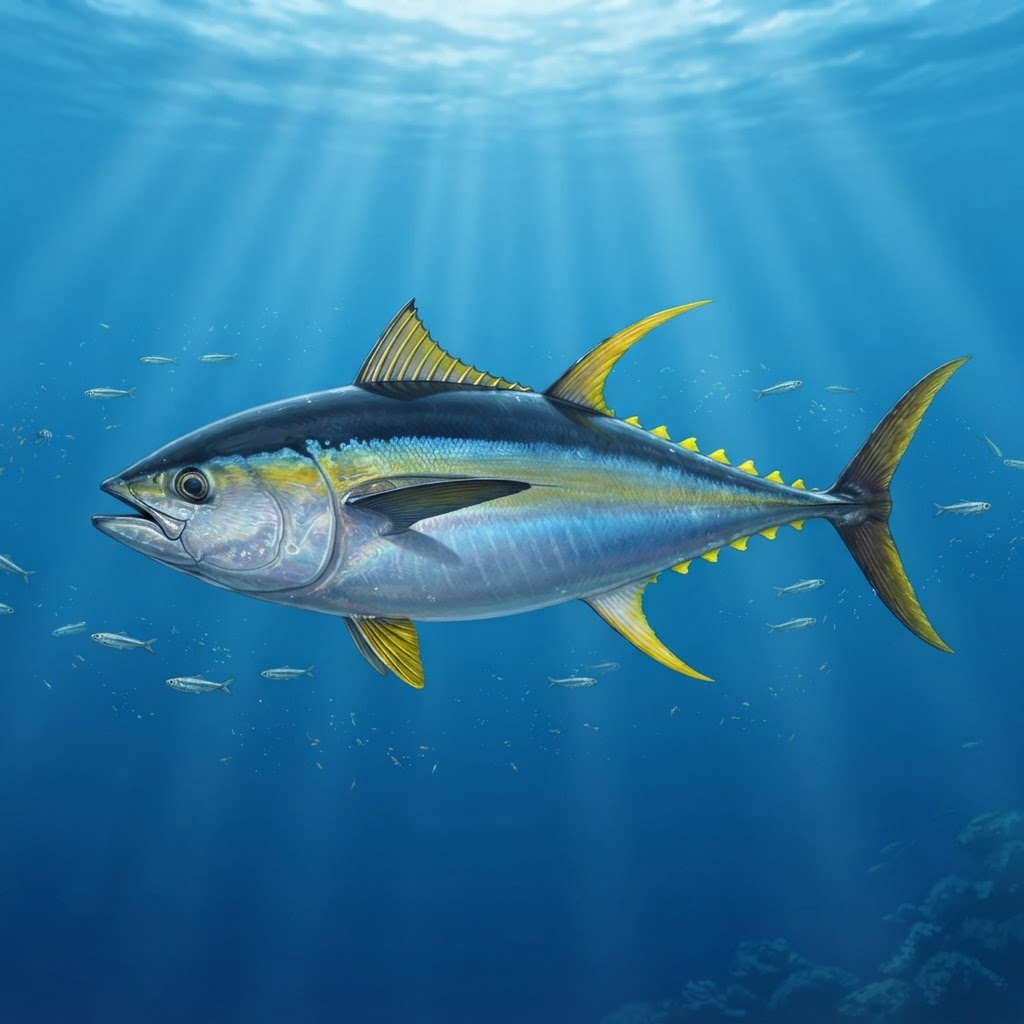
Yellowfin Tuna
Thunnus albacares
The ultimate test of endurance, the Yellowfin Tuna is a torpedo of pure muscle and power that defines blue-water big game fishing.
Typical Size
40 lbs to 150 lbs, with trophy-class fish exceeding 200 lbs.
Prime Seasons
Summer and Fall are prime, though they can be found year-round in tropical latitudes.
Overview
Yellowfin tuna are apex predators of the open ocean, renowned for their incredible speed, explosive strikes, and long, grueling fights. They are highly migratory, pelagic fish that school by size and are often found in the company of porpoise pods or floating debris in the deep blue offshore waters. Anglers target them for their top-tier performance on light-to-medium tackle and their status as the gold standard for sashimi.
Because of their schooling nature and aggressive feeding habits, yellowfin can be caught using a variety of techniques, ranging from live-bait fishing under birds to high-speed trolling. Their stamina is legendary, often taking runs that can strip hundreds of yards of line off a reel in seconds, making them the favorite challenge for serious offshore sport fishermen.
Identification
- Bright yellow anal and second dorsal fins that are elongated in larger adults
- Sleek, torpedo-shaped body built for immense speed
- Dark metallic blue back fading into a silver/white belly
- Vertical, wavy white lines on the lower flanks
- Absence of teeth on the vomer
Habitat
Diet & Forage
Behavior & Feeding
Yellowfin tuna are highly active, opportunistic predators that primarily feed on baitfish, squid, and crustaceans during daylight hours, often hunting in large schools. They exhibit significant aggression and can be found in a frenzied feeding state known as 'boiling' when targeting bait balls at the surface. These fish are highly migratory, frequently traveling thousands of miles to track shifting thermoclines and nutrient-rich currents, with activity peaking during the transition between dawn and dusk.
Spawning
Yellowfin tuna spawn in tropical and subtropical waters year-round, though activity often surges in warmer months when sea temperatures exceed 75°F. Spawning typically occurs in the open ocean where females release hundreds of thousands of eggs in batches over multiple nights. While spawning behavior does not necessarily stop these fish from feeding, it can cause them to become more scattered or finicky, requiring anglers to adjust gear to lighter fluorocarbon leaders.
Water Temperature
Weather Triggers
Approaching Low Pressure Front
Often triggers a 'pre-frontal' feeding frenzy as barometric pressure drops.
Steady Cloud Cover
Reduces UV penetration, allowing fish to remain closer to the surface for longer durations.
Calm, Glassy Water
Makes fish extremely boat-shy; requires long-casting techniques and small diameter terminal tackle.
Depth by Season
Best Lure Rigs & Setups
Live Bait 'Fly-Line' Rig
When: Crucial when fish are 'breezing' or working bait near the boat.
Setup: 80lb fluorocarbon leader, 2/0 to 4/0 circle hook, no weight.
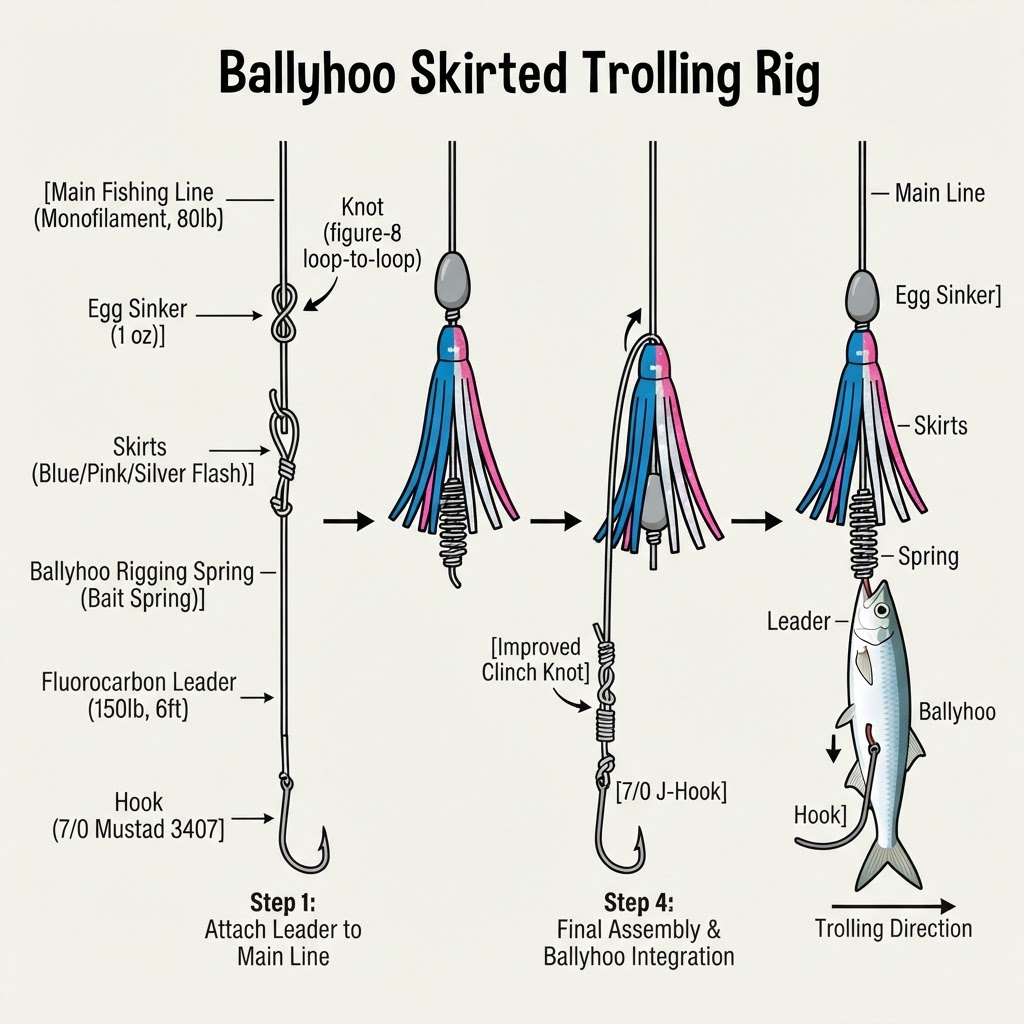
Trolling Skirt/Bait Combo
When: When searching open water for roaming schools.
Setup: Heavy offshore rod, 80lb mono mainline, skirted lure head with rigged ballyhoo.
Vertical Jigging Setup
When: When fish are holding deep on structure or thermoclines.
Setup: 200g-300g butterfly jig, 80lb braided mainline, 60lb fluorocarbon leader.
Topwater Popper
When: Aggressive surface feeding frenzy.
Setup: Heavy spinning gear, 65lb braid, 60lb fluorocarbon leader, large 5-inch popper.
Best Knots
Rigs From The Library For Yellowfin Tuna
Catch more yellowfin tuna — free
Create a free account and unlock the full angling toolkit:


