Tarpon
Megalops atlanticus
The Silver King is the ultimate prize in saltwater fly and light-tackle fishing, legendary for its acrobatic jumps and sheer stubborn power.
Typical Size
60 to 150 lbs, though specimens exceeding 200 lbs are occasionally landed.
Prime Seasons
Late spring through early fall; peak migration varies by region, with May and June being prime in Florida.
Overview
The Atlantic Tarpon is a prehistoric, bony fish that commands respect for its incredible endurance and spectacular aerial displays. Weighing well over 100 pounds, these giants possess heavy scales that give them their signature metallic, silver-plated appearance, earning them the nickname 'Silver King.' Anglers seek them out not just for the challenge of the fight, but for the refined skill required to hook them in the first place.
Targeting Tarpon requires finesse, precision casting, and the ability to 'bow to the king'—lowering the rod tip when they jump to prevent the hook from tearing out of their notoriously hard, sandpaper-like mouths. They are highly migratory and sensitive to water quality, making the hunt a pursuit of both biology and strategy.
Identification
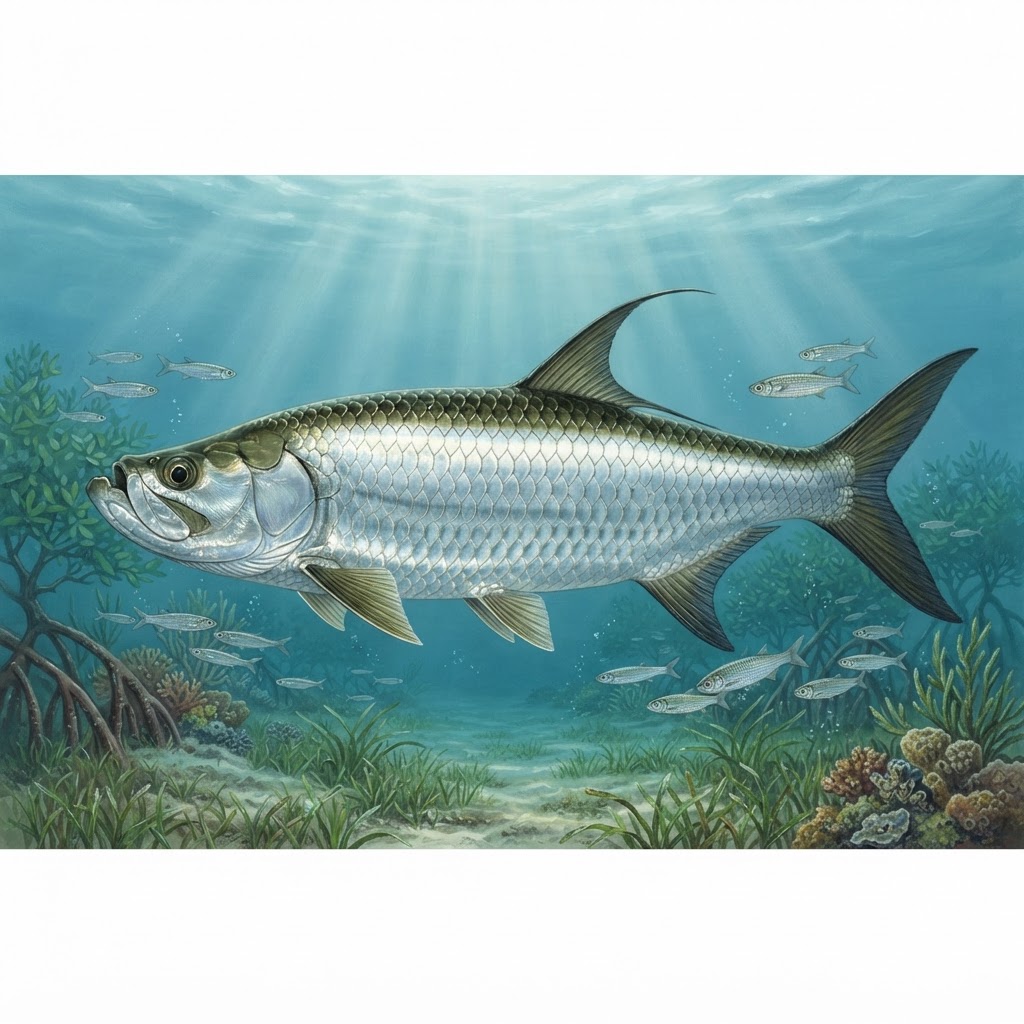
- Large, thick, silvery scales covering the body
- Deeply forked tail fin designed for bursts of speed
- Prominent, upturned lower jaw for surface feeding
- Elongated final dorsal ray extending into a distinct filament
- Huge, dark eyes adapted for low-light hunting
Habitat
Diet & Forage
Behavior & Feeding
Tarpon are opportunistic predators that primarily feed on baitfish, crustaceans, and mullet, often cruising along shorelines or staging in deep channels. They exhibit high levels of activity during low light periods like dawn and dusk, though they can be sight-fished throughout the day in clear, shallow water. Their aggression varies significantly based on water temperature and migratory status, shifting from lethargic in cool months to highly active during peak summer pulses. They engage in predictable seasonal migrations, moving northward along the coast as water temperatures rise and retreating to deeper, warmer waters when winter sets in.
Spawning
Tarpon spawning typically occurs offshore in deep water during the late spring and summer months, often coinciding with full or new moon cycles. Optimal spawning temperatures generally range between 80°F and 85°F, which draws large concentrations of breeding adults toward coastal passes and inlets. While anglers rarely target them during the actual spawning act, the pre-spawn staging phase provides the most reliable fishing opportunities as fish transition into breeding grounds. Successful spawning runs often result in massive, visible schools of fish that are highly receptive to well-presented baits, provided they haven't been pressured by heavy boat traffic.
Water Temperature
Weather Triggers
Falling Barometer
Often triggers an intense, short-term feeding frenzy as fish sense atmospheric pressure changes.
Cold Front
Significantly suppresses activity; fish head to deep, stable-temperature holes and ignore most offerings.
Overcast Skies
Increases willingness to eat in shallower water, as it reduces visibility and makes the fish feel less exposed.
Depth by Season
Best Lure Rigs & Setups
Live Mullet Rig
When: Best for targeting large, cruising fish in inlets.
Setup: 80lb fluorocarbon leader, 7/0-9/0 circle hook, no weight or a small split shot to keep bait near the surface.
Tarpon Toad Fly
When: The standard for shallow water sight-fishing.
Setup: 12-weight rod, 80lb fluorocarbon shock tippet, floating fly line with a slow-sinking fly profile.
Soft Plastic Swimbait
When: When fish are feeding on migrating bait schools.
Setup: 6-8 inch paddle-tail swimbait on a heavy-duty 4/0-6/0 swimbait hook, 60lb braided main line, 80lb leader.
Best Knots
Catch more tarpon — free
Create a free account and unlock the full angling toolkit:
Latest from the Community

Trail Cam
Whitetail doe
Admin Josh · 3d ago

Posted
Ready For My Extended Archery Deer Hunt
Richard Taggart · 3d ago

Trail Cam
Untitled
Jagger Feazel · 3d ago

Posted
Venison Burgers
Richard Taggart · 4d ago

Trophy
Throwback to 2010
Jeffrey Cote · 4d ago

Posted
Last Day of the Archery Elk Hunt
Richard Taggart · 5d ago